
Ways To Lower Blood Pressure Quickly
Most of you who have decided to use our program, want to lower your blood pressure to normal levels as fast as possible. The techniques below will help you achieve that along with the techniques to address the underlying cause.
The following techniques are simple to do, you cannot over do them (can’t create low blood pressure for example), simply follow the technique. The video demonstrations are best so you can see exactly where to press and hold.
Hand Acupressure
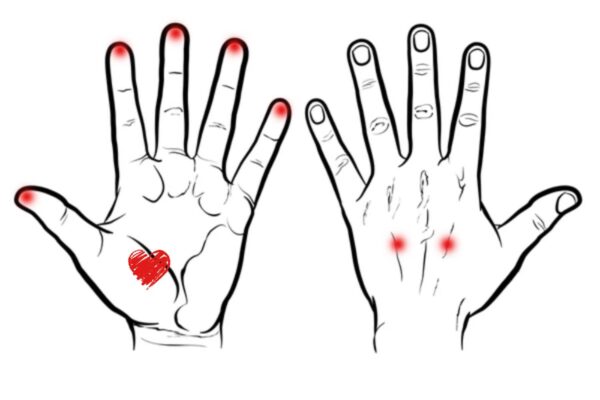
There are two types of Acupressure we use in this program The first is a pressure massage type, firm pressure on the points in the diagram.
Step 1: Press and release firmly on the heart area with your thumb for a minute or two, when you release still keep in contact with the area.
Step 2: Massage in a clockwise then anticlockwise motion on the heart spot, for at least 2 minutes – 5 minutes if you can.
Step 3: Then massage each of the finger pads for 30 seconds to a minute, press and release a few times then firmly massage these points. They relate to stress which is a common cause of blood pressure issues.
Step 4: Press and release, massage clockwise and anticlockwise for 30 seconds on the points on the back of the hand. These relate to the Kidneys which are also important for blood pressure.
This is a simple technique to use daily, you can do it more than once too. But even after a few days of doing this you should start seeing changes in your blood pressure readings.
To make even faster progress use the following acupressure also.
Video - Acupressure
Jin Shin Jyutsu
Jin Shin Jyutsu is a Japanese form of acupressure where you hold rather than press on the points. Also the points will pulse after you hold them for a period of time. If you can’t feel the pulsation, don’t worry.
It can take a few days or longer before you can feel this, but feeling them pulse doesn’t make them work any better. Holding them is the key, if you can’t feel them pulse, hold them for 2-3 minutes or more.
They are simple to do while watch TV for example.
Also the points are not small, they are the size of your palm, so you won’t miss the area. You can sit, stand or even lie down while holding them. So just get comfortable and rest your hands on the following points.
Do them each day, once you can feel them pulse, if they pulse within a few seconds and do this each time you check them. Then after a week or two you can stop using these, except the Fingers/Palm technique and even the breathing. These are great long term techniques to help keep you in balance once balance is achieved.
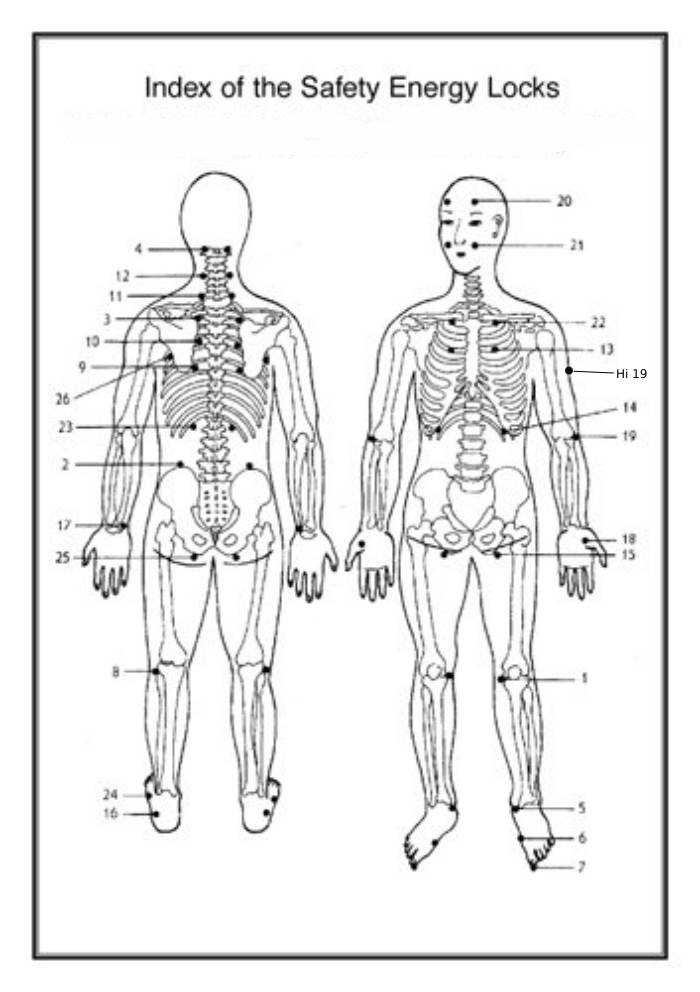
Below are the points (SEL’s) and Flows listed to help. Each point is numbered so refer to the chart of points, but the video demonstrations are best to see the process.
SEL’s
Hold the points 25, 4, and hi19
FLOWS
Balance Blood Pressure – hold hi19 + the opposite 1, then 19 + the opposite 1, then 19 +the opposite 16, then 19 + the opposite 7
To get the energy moving and circulating which helps drop tension with the heart – hold 11 and 15 on the same side, then 11 and 25 on the same side
For High BP – hold the RIGHT sacrum and same side hi19, this can lower blood pressure quickly
Video - Jin Shin Jyutsu
Breathing
Breathing obviously is essential for life, however, you may not know that every joint moves when you breathe. You also breathe in energy and breathe out stress.
If our breathing cycle is disjointed, then we hold onto to stress and as we know stress can elevate blood pressure.
There is a very simple breathing technique that helps to deepen your breathing and make it more circular – meaning no pauses in the cycle which cause tension.
Again the video will demonstrate the hand position, but you basically place your hands under your armpits with your thumbs resting on the centre of your chest.
You then just count your breathing, a breath in and out is one count. No need to change how you breathe, you can breathe in and out your nose or mouth, whichever you find most comfortable.
You count 36 cycles of breathing, in a relaxed easy manner.
What happens is like the proverbial “a watched kettle never boils”. By counting your breath, the breath will naturally slow and deepen (you don’t try to do this you just watch and it occurs naturally). So the first breath is quite short compared to the 36th breath.
What you may notice also, is that after counting for a while, you may lose count, your mind wanders and you start thinking of things you need to do. You may yawn, sigh, or even feel sleepy.
These are all signs of your body releasing stress and tension. So if you lose count, you start back at one.
If you can do a full 36 cycles of counting your breath, then your breathing is good. Practice this each day, you can also count your breathing (without the hand position) while you walk for example. (Don’t do it while you’re driving as you may lose concentration).
This technique is like the technique below, it is a Jin Shin Jyutsu technique that gives the whole body a good boost, reduces stress and tension, boosts energy and so much more. And very simple to do.
Fingers & Palm
Each of the fingers covers a different aspect of your body, physically and emotionally. The video again demonstrates the technique but you simple hold (not tightly) each finger and your palm, individually until it pulses.
If you can’t feel the pulse just hold each for a minute. You do it on both hands. Each finger relates to different aspects of the body – physical areas, systems and functions within the body and emotions/mental attitudes.
Here is a brief overview of each.
Thumb – relates to Insomnia, Digestion (tummy ache – great for kids), Headaches (especially base of thumb), Stress and nerves, To ground, calm and nurture, Skin surface, Stomach and Spleen energy, When have to SIT a lot (sitting creates bloat conditions)
Index – relates to Teeth and gums, Backaches, Digestion, constipation, Self criticism, shyness, Muscle tension, Kidney and bladder energy, When have to STAND a lot (be on your feet)
Middle – relates to Blood pressure, General fatigue, Eyes, vision, Irritability, Balance emotions, Liver and gallbladder energy, When have to READ a lot
Ring – relates to Ringing in the ear (Tinnitus), Respiratory functions, Excessive mucus, Skin conditions, Lung and large intestine energy, When have to RECLINE a lot (e.g. convalescence)
Little – relates to Heart discomforts (e.g. palpitations, blood pressure), Bloating, Trying too hard (at anything), Insecurity, nervousness, Heart and small intestine energy, When need to WALK a lot
Palm – relates to Harmonises our whole being on a physical, mental, emotional and soul level, Helps to lift despondency or depression , Helps fatigue
Reflexes
Our body is governed by reflex type actions, from musculo-tendon reflexes such as tapping below your knee and your left shoots out, to stress reflexes, immune reflexes and more.
However there are two reflexes that are common that can help create high blood pressure. One relates to the Diaphragm and the other the upper back and rib cage.
The Diaphragm is the muscle we use to breathe with, you can’t rest it as you can hold breath for 30 minutes. It is a muscle that you can’t really stress or massage.
The Diaphragm also has the same pain pattern as your heart, can help cause anxiety, elevate blood pressure, cause fatigue, headaches and so much more.
The 36 Breathing Jin Shin technique helps with the Diaphragm but the reflex technique below can relax it quickly and is a good technique to do often (a few times a day for a week), even long term good to use after stressful situations, or after doing heavy work at home or at work.
All you do is turn your head to one side, drop your arm down the opposite side. Cough 2-3 times – there cough should be a quick sharp cough, not trying to cough your lungs out but a rapid cough that shocks the Diaphragm, again the video demonstrates.
The other reflex which helps take tension off your upper back and ribs is even easier to do.
Lie on your back, raise your arms above head and then look up with your eyes, making sure you don’t move your head ONLY your eyes. Hold for 30 seconds to 2 minutes. Great to do after a busy day sitting, but can ease tension almost immediately in the upper back and ribs.
Video - Reflexes
Water
Drinking water is essential not just for blood pressure but for overall health – sip not gulp water though. Everyone asks how much?
Everyone is different, but if you lift the skin off the back of your hand and then let it go: if it springs back immediately then hydration levels are good. If it is slower to return then hydration is not so good.
A simple trick with water too, is that if you fill your bottle or glass with a quarter clear (unsweetened) apple juice and the remainder water, this tricks the body to process water better. It helps with cellular hydration, better than drinking water alone.
You don’t need to do this all the time, but having a few glasses a week like this helps get your body to hydrate better, along with sipping water too. But about 2 Litres of water is plenty, but gauge it on your activity levels. Water bottles are great as it is easier to see how much you have drunk in the day too.